
SEO vs GEO: What Is the Difference?
In the digital marketing world, search behavior is changing rapidly. For years, businesses focused mainly on SEO (Search Engine Optimization) to improve their visibility on Google and other search engines. Today, the rise of AI-powered search tools such as ChatGPT, Google AI features, and other answer engines has created a new opportunity called GEO (Generative Engine Optimization).
Although SEO and GEO have similar goals—improving online visibility—they focus on different types of search experiences.
What Is SEO?
SEO, or Search Engine Optimization, is the process of improving a website so that it can rank higher in traditional search engine results.
The main goal of SEO is to attract organic traffic from search engines such as Google and Bing.
SEO commonly includes:
- Keyword research
- On-page optimization
- Technical SEO
- Content creation
- Link building
- Local SEO
- Website speed optimization
- Mobile optimization
- Image optimization
- Internal linking
For example, if someone searches for “digital marketing expert in Perinthalmanna,” an SEO strategy aims to make your website appear prominently in the traditional search results.
What Is GEO?
GEO, or Generative Engine Optimization, focuses on improving the chances that your content will be understood, selected, and mentioned by AI-powered search and answer engines.
Instead of simply producing a list of links, generative engines can provide users with a direct answer based on information gathered from multiple sources.
GEO focuses on creating content that AI systems can easily understand, trust, and use when generating answers.
GEO strategies may include:
- Creating clear and useful answers
- Providing accurate and well-structured information
- Demonstrating expertise and credibility
- Using clear headings and question-based content
- Supporting claims with trustworthy sources
- Covering topics comprehensively
- Keeping information accurate and up to date
- Structuring content so important information is easy to identify
SEO vs GEO: Key Differences
| SEO | GEO |
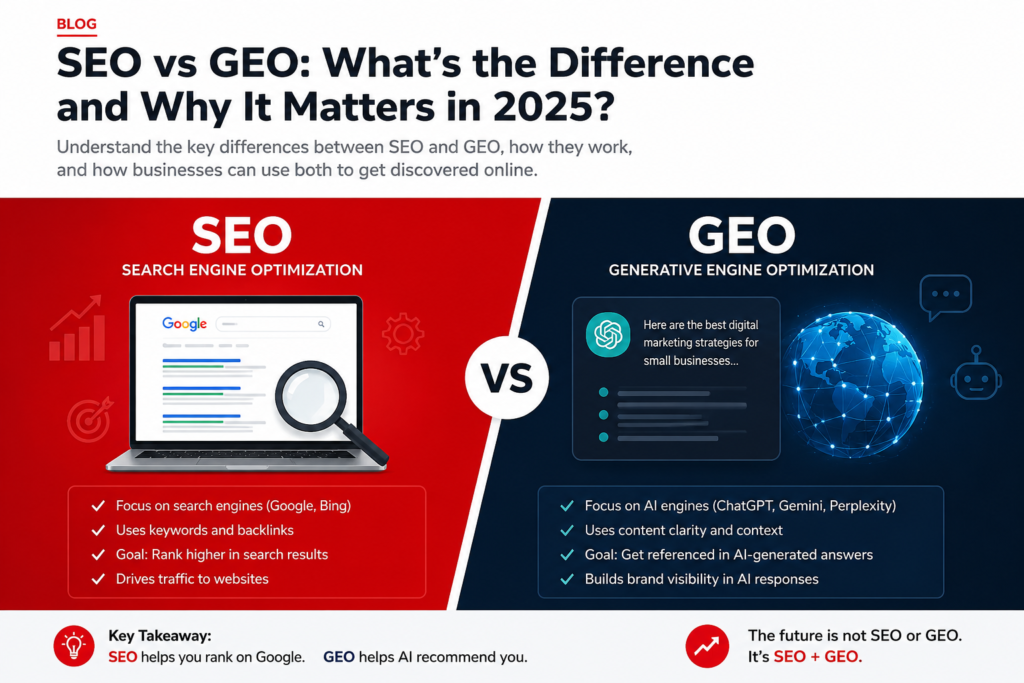
| Focuses on traditional search engines | Focuses on generative AI and answer engines |
| Goal is higher search rankings | Goal is greater visibility in AI-generated answers |
| Targets search engine result pages | Targets AI-generated responses |
| Uses keywords and search intent | Uses clear, comprehensive, answer-focused content |
| Backlinks are an important signal | Authority, clarity, and reliable information are important |
| Measures rankings and organic traffic | Can involve AI mentions, citations, visibility, and referral traffic |
| Optimizes webpages for search engines | Optimizes information for AI-driven discovery |
Why Is SEO Still Important?
GEO does not replace SEO.
Traditional search engines continue to generate significant traffic for businesses. A strong SEO foundation can help search engines discover, crawl, understand, and rank your website.
Important SEO fundamentals—such as useful content, technical performance, relevant keywords, internal links, and good user experience—remain valuable.
Why Is GEO Becoming Important?
People are increasingly using AI tools to ask questions instead of searching only through traditional search results.
For example, instead of searching:
“Best digital marketing services in Perinthalmanna”
a user might ask an AI tool:
“Who are the best digital marketing experts in Perinthalmanna for SEO and social media marketing?”
The answer engine may generate a direct response and mention selected businesses or websites.
This means businesses need to think beyond traditional rankings and consider how their information can be discovered and represented in AI-generated answers.
How Can You Use SEO and GEO Together?
The best strategy is not SEO vs GEO. It is SEO + GEO.
You can combine both approaches by:
- Researching your audience’s questions
Identify the questions your potential customers are asking. - Creating helpful content
Answer those questions clearly and provide genuine value. - Using relevant keywords naturally
Optimize your content for the searches your audience actually makes. - Building topical authority
Create multiple useful pieces of content around related topics. - Demonstrating expertise
Include accurate information, examples, experience, and trustworthy references where appropriate. - Improving technical SEO
Make sure search engines can crawl and understand your website. - Structuring content clearly
Use descriptive headings, short paragraphs, lists, FAQs, and easy-to-understand explanations. - Keeping information updated
Regularly review important content and update outdated information.
SEO and GEO for Local Businesses
Local businesses can benefit from both strategies.
For example, a digital marketing professional serving Perinthalmanna, Malappuram, and Kerala can create content around topics such as:
- Digital marketing services in Perinthalmanna
- SEO services in Perinthalmanna
- Social media marketing for local businesses
- How local SEO helps businesses
- Best digital marketing strategies for small businesses
- SEO vs GEO for local businesses
SEO can help these pages appear in traditional search results, while well-structured and authoritative content can increase the possibility of being useful to AI-powered answer systems.
Conclusion
SEO and GEO are different but complementary digital marketing strategies.
SEO focuses primarily on improving visibility in traditional search engines, while GEO focuses on making information useful and discoverable within generative AI and answer-engine experiences.
The future of search is likely to involve both traditional search results and AI-generated answers. Businesses that create helpful, accurate, authoritative, well-structured content can build a stronger foundation for visibility across both environments.
In simple terms:
SEO = Optimize for search engines.
GEO = Optimize information for generative AI and answer engines.
Best approach = Use SEO and GEO together.